
Well integrity status, tests and annulus pressures that stand up to audit and review.
BarrierLedger holds the register you already keep, assesses every monitored annulus against the MAWOP/MAP values in your own integrity policy, and keeps the inputs and the reasoning behind each status.
Per-well pricing · Excel-first import · a method profile per well type
The dashboard
The whole register on one screen.
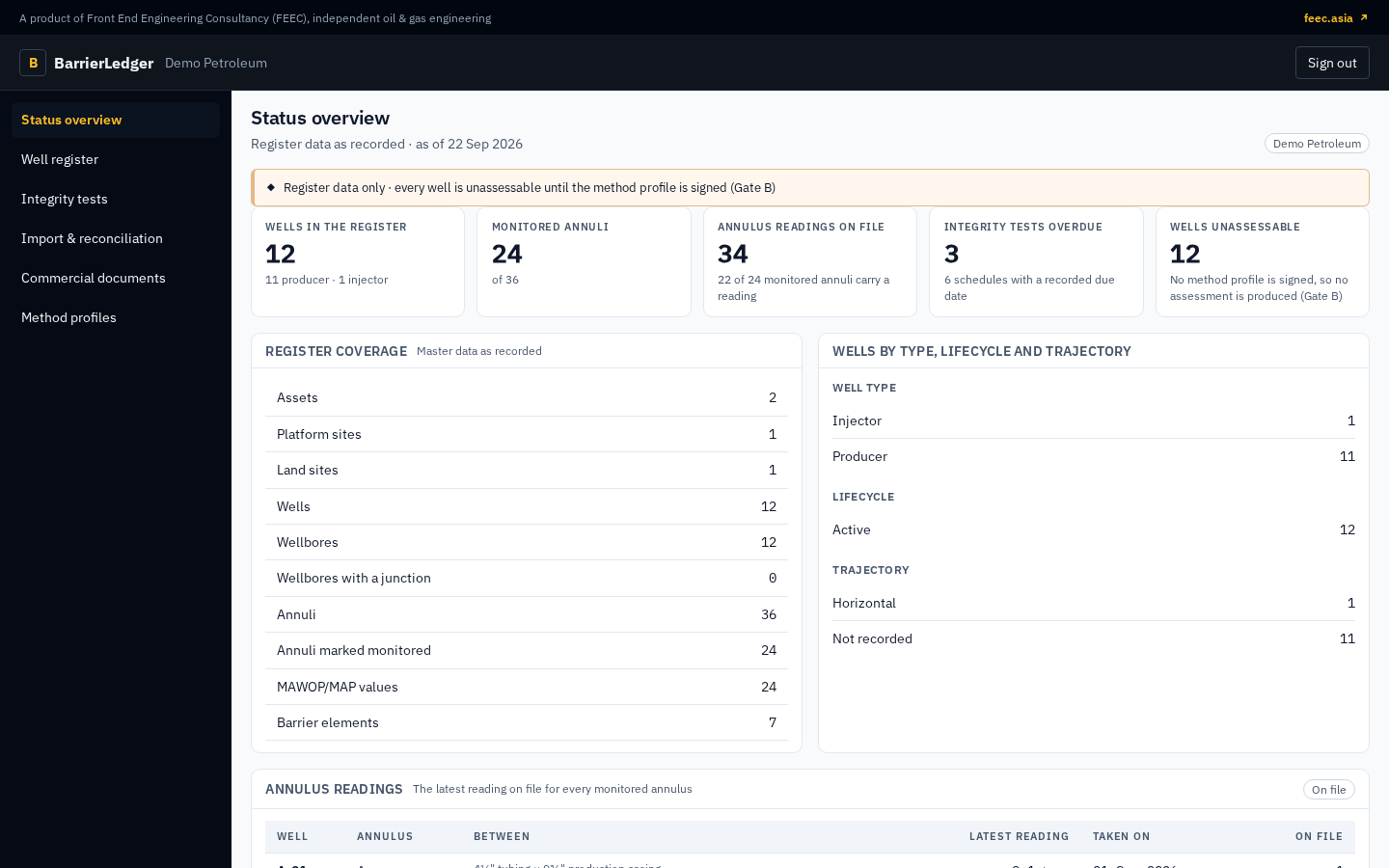
Coverage, every monitored annulus with its latest reading, the tests due and overdue, and the data-quality flags that need an answer — before a review asks for them.
The problem
The barrier register is usually one person and one spreadsheet.
Status nobody can defend.
The register says green because that is what it said last month. When someone asks why, the reasoning is in someone’s head.
Annulus pressure compared by eye.
Readings arrive weekly and are checked against a MAWOP figure that lives in a different file — if it exists at all.
Overdue tests found late.
Evidence sits in an email folder, and the first time anyone notices an overdue test is in a review.
How it works
One method, applied to your own data.
- Step 1
Your register goes in
The spreadsheet you already keep, plus the policy or study your MAWOP/MAP values come from. Column mapping and per-row validation run on import.
- Step 2
The platform reconciles it
Every status and limit it can check is compared against your own figures, and every difference is listed with its reason.
- Step 3
Every annulus is assessed
Each monitored annulus is classified against the method profile for that well type — the bands, trend rules and exceptions the profile defines, with no thresholds invented in the product.
- Step 4
The review is signed and kept
An assessed register, a per-well status report and an immutable history: the inputs, the profile version and the approvals behind every status.
The platform
Six records that make a status defensible.
Integrity work fails on the details: which limit applied, which reading was used, which test closes the gap. Each of these is a first-class record.
Well register
Wells, boreholes, strings, cement tops, packers, wellhead and tree components, with barrier envelopes versioned per well.
Annulus pressure
Bulk historical import plus a weekly or monthly template, with A, B and C annuli held per well.
MAWOP/MAP bands
Each monitored annulus carries its own limit as master data, with its source, date and reference.
Integrity tests
Test types and frequencies from your own policy, with due and overdue tests beside the well.
Schematics
Vertical, deviated, horizontal and multilateral wells drawn from the register, gaps flagged rather than guessed.
Import and reconciliation
A template that mirrors your register, per-row validation, and every difference listed with its reason.
The deliverable
Not a dashboard demo — a defensible record.
An assessed register you can reconcile line by line against your own, with the status and the reasoning beside each well.
Per-well status reports with the barrier schematic, the annulus table, the governing limit and its source, and the test history.
A reconciliation note that names every difference between the platform and your register, and why it exists.
A data-quality list of what is missing, stale, unmapped or inconsistent in your register — usually the most useful page in the pack.
Solutions
Three people, three different first question.
The same register, read differently — and the same platform answering each of them.
Integrity engineer
The register, the governing limit and its source, and a status that can be explained without remembering why.
Wells manager
A monthly review with a state, overdue tests aged before the review finds them, and period locking that keeps the old version.
Asset integrity lead
Every asset on the same profile and vocabulary, so portfolios are comparable and gaps are visible early.
Regimes
Built around the regimes operators answer to.
The regulations page names each regime, what it asks of a well-integrity programme, and the public document behind every statement.
United Kingdom
North Sea Transition Authority (NSTA), with OPRED as the offshore environmental regulator
2 public sources cited
Read the detail →United States
Bureau of Safety and Environmental Enforcement (BSEE), US Outer Continental Shelf
3 public sources cited
Read the detail →Canada
Provincial: Alberta Energy Regulator (AER) and the BC Energy Regulator (BCER)
4 public sources cited
Read the detail →Australia
NOPSEMA (offshore safety and well integrity, Commonwealth); NOPTA is the Titles Administrator; onshore wells sit under state regimes
4 public sources cited
Read the detail →
No regulator approves us
From the product
The working views, captured from the running application.
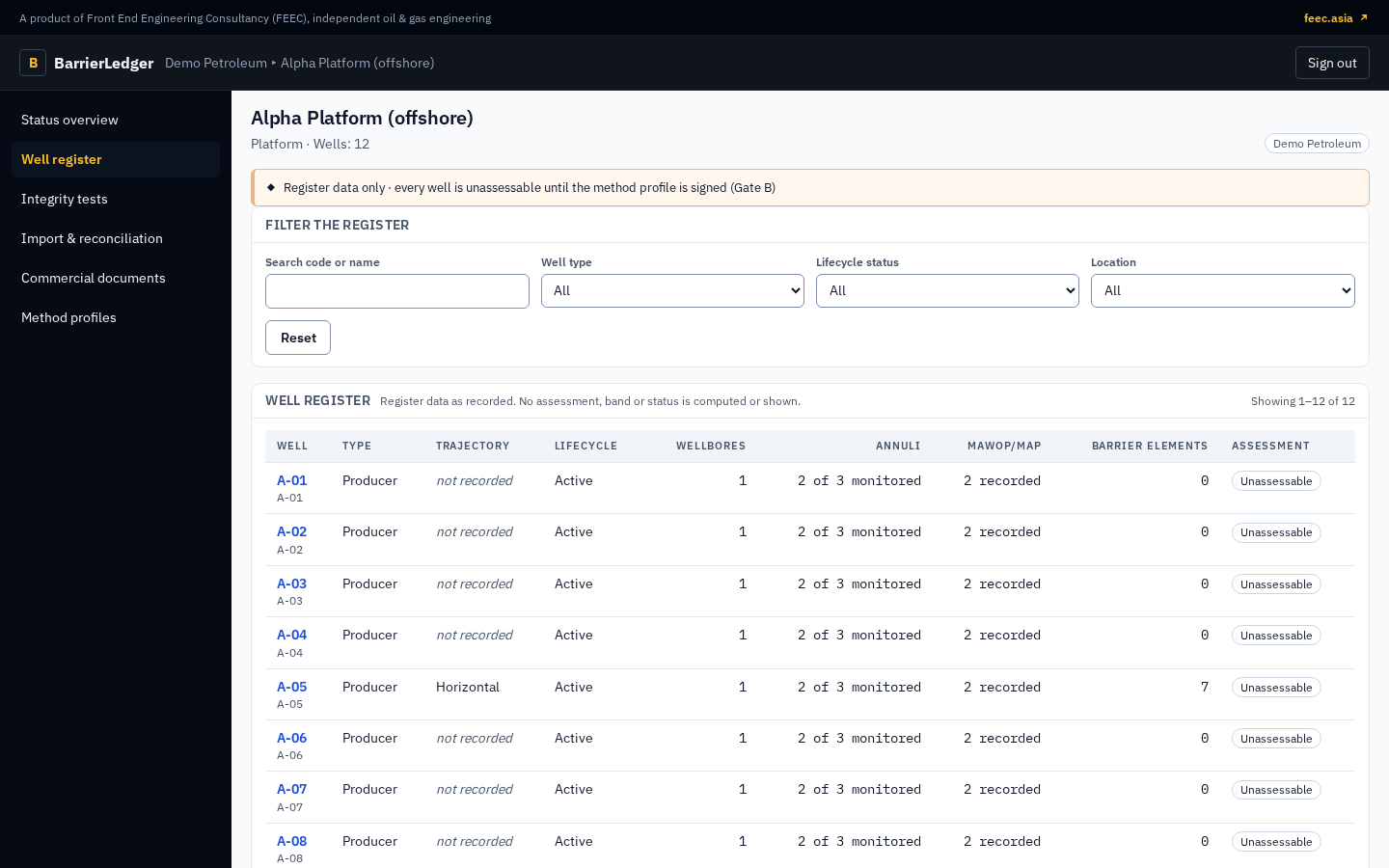
Status overviewDemo Petroleum — fictional demo tenant data Well registerDemo Petroleum — fictional demo tenant data 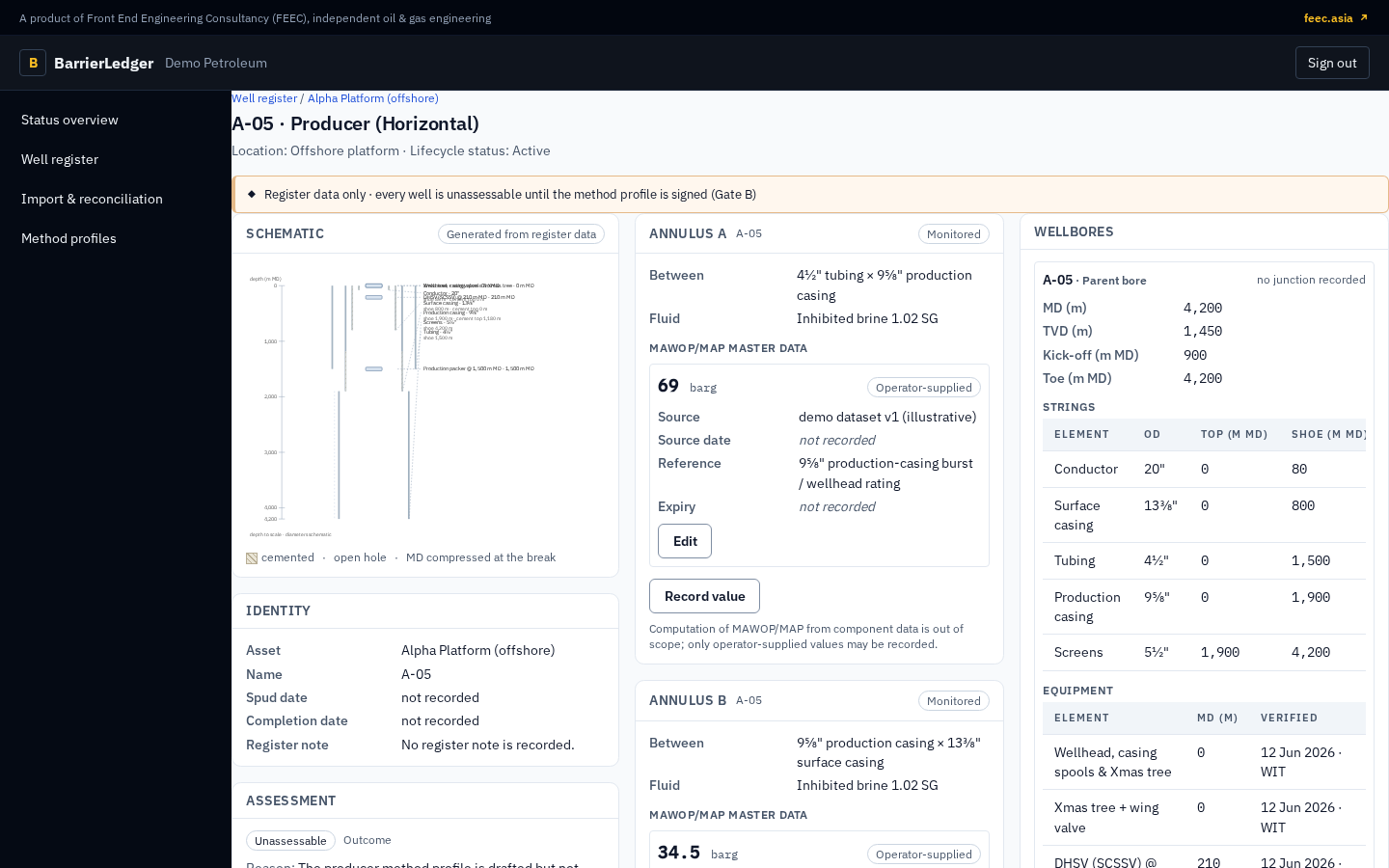
Well detail & schematicDemo Petroleum — fictional demo tenant data 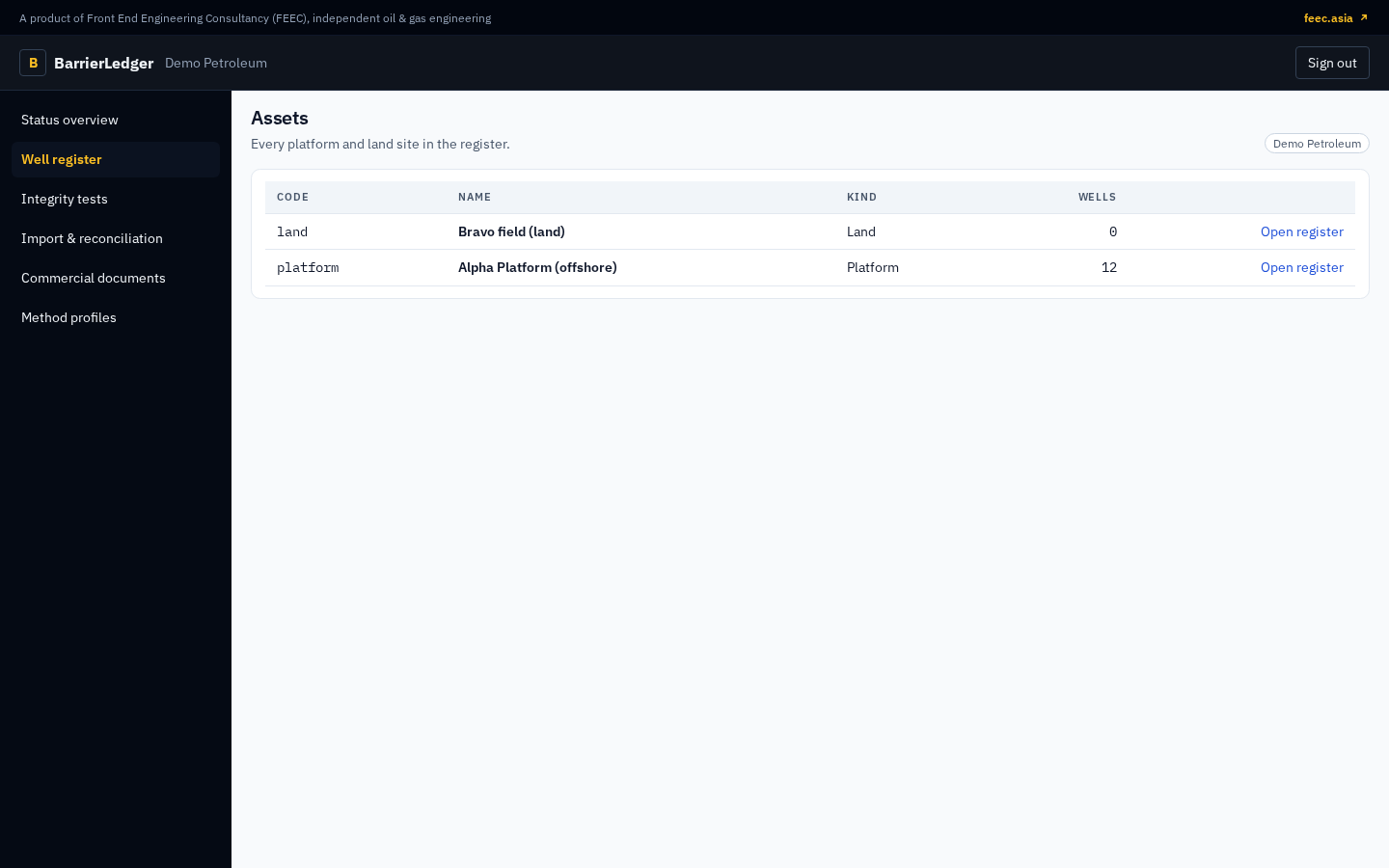
Assets registerDemo Petroleum — fictional demo tenant data 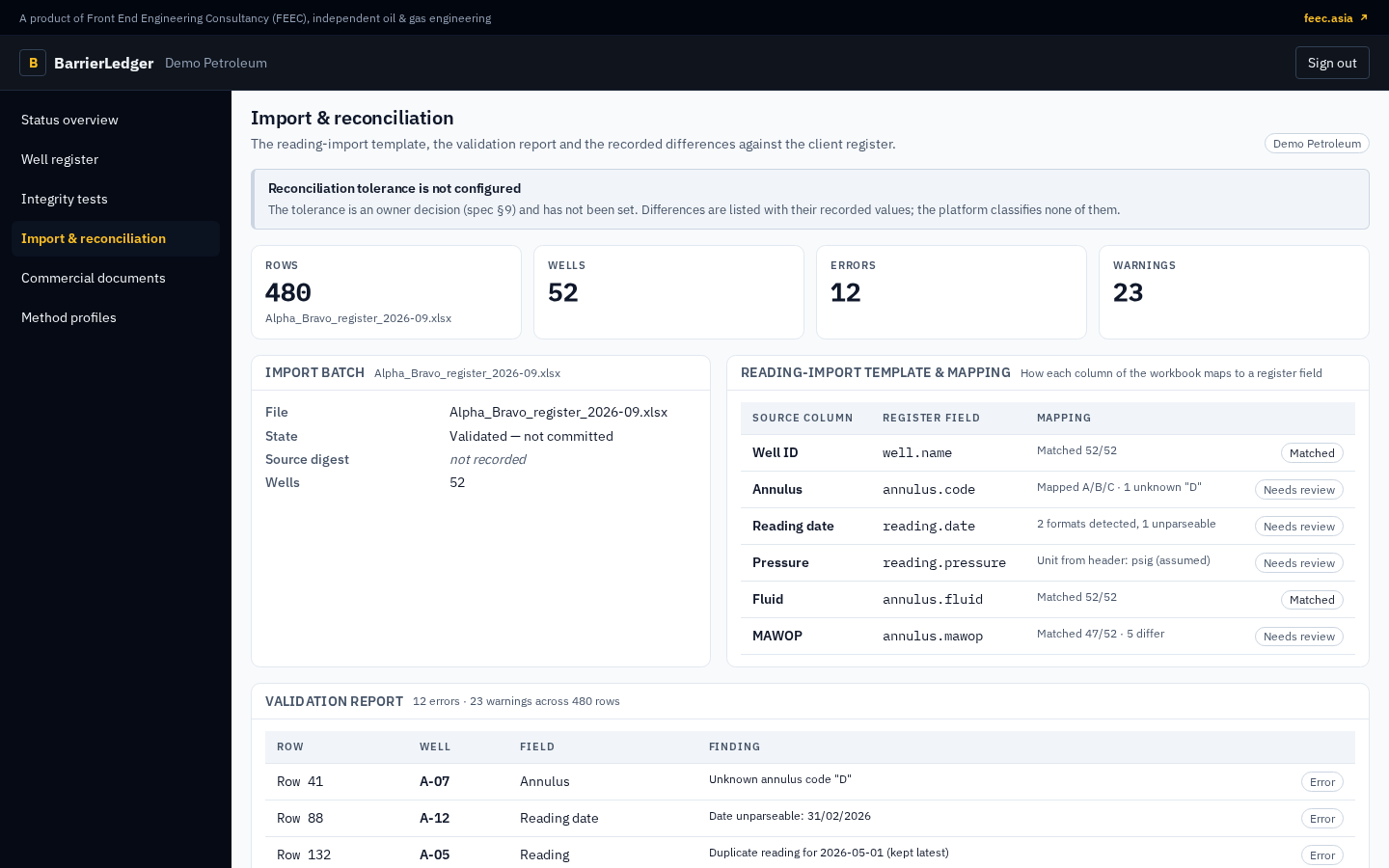
Import & reconciliationDemo Petroleum — fictional demo tenant data 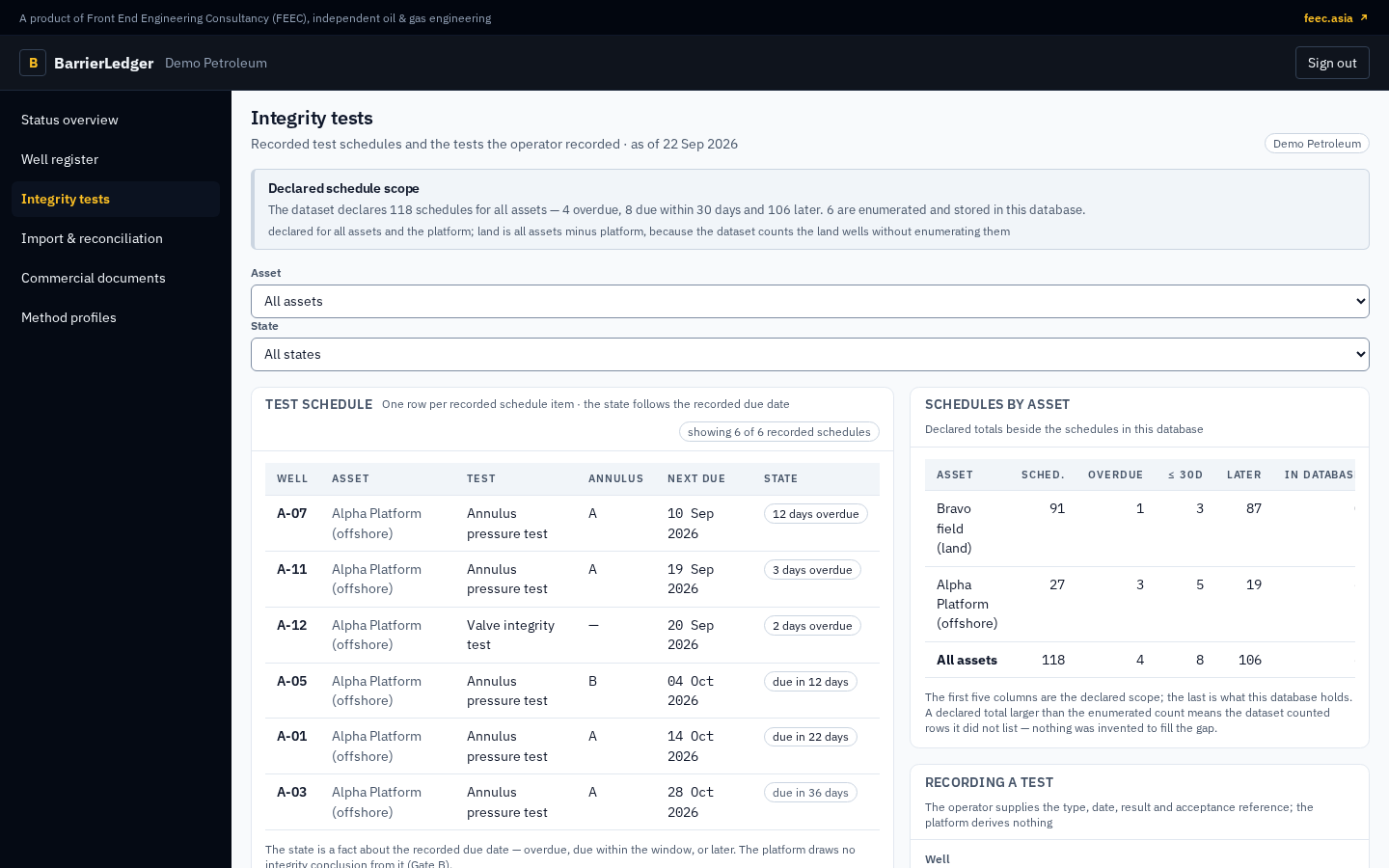
Integrity testsDemo Petroleum — fictional demo tenant data 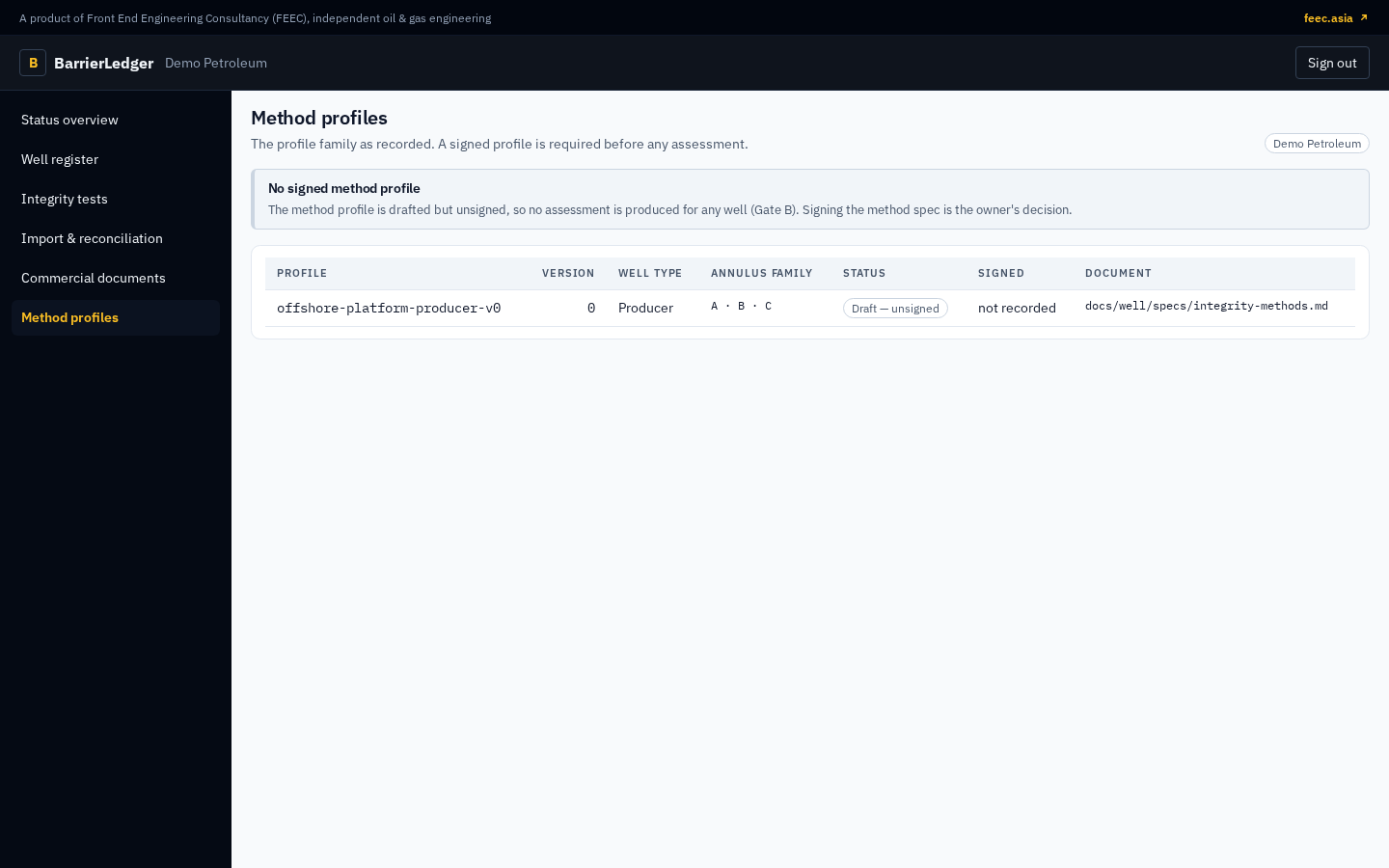
Method profilesDemo Petroleum — fictional demo tenant data
Security and trust
Isolated by construction, and honest about what is not claimed.
One tenant per client
Own register, profiles, users and history. Isolation is enforced in the database, not filtered in application code.
A live register off the shared host
Dedicated hosting or your own infrastructure holds customer data; the shared host carries the fictional demo tenant.
Provenance on every run
Inputs hash, source-file hashes, method-profile version and engine build recorded with each assessment.
Overrides need a second person
A reason is mandatory, an unapproved override is not in effect, and the computed result is never rewritten.
The method is yours, and it is versioned
One profile per well type
Pricing
Priced per well, with the assessment method stated up front.
Plan bands, hosting options and fixed-fee services are set out in full, with a builder that turns your well count into a first-year total.
- The unit is the well, not the asset.
- Pilot, Essentials, Professional and Enterprise bands.
- Shared, dedicated and self-hosted hosting.
- Fixed-fee engineering services stand on their own.
About
A FEEC product, built by the engineers who write the method.
Front End Engineering Consultancy Limited is an independent engineering consultancy. BarrierLedger is its well integrity product; EmitLedger, its emissions accounting product, shares the engineering standards, not the tenants.
FAQ
Questions we get asked first.
“Excel works.”
It does — until the person who maintains it is away, or someone asks how a status was decided. We are not replacing your spreadsheet as a data store first; we are replacing the reasoning that is missing from it. Import it, reconcile it, keep exporting it.
“Our wells are unusual.”
Before a well is assessed, the method for its type is written down and versioned, and every assessment records the profile version it used. If your wells need different rules, that is a method conversation, not a code change.
“Is our data safe?”
Real data goes only onto a dedicated host, never a shared one; a DPA is signed before anything is shared; and you can ask for a full export or deletion.
“What about regulators?”
We do not produce regulatory submissions and we do not file anything on your behalf. The platform produces in-house integrity reports — the record you prepare your submissions from. You remain responsible for regulatory submissions and official well records.
Which well types can be assessed?
Method profiles are per well type, and one profile never serves another. Each well type is assessed against its own method profile, so a result is never carried across types to make a plan or a dashboard look complete.
Where does the MAWOP or MAP value come from?
Each monitored annulus carries its own MAWOP/MAP value as master data with its source, date and reference, imported with your register or entered directly. The platform compares readings against that value; it does not derive the value from component ratings.
What happens when a well cannot be bled to zero?
The method proposes that a well that cannot be bled to zero is treated as a first-class exception path rather than a footnote: the assessment records the exception, the flag and whether it blocks the review. The definition of SCP and the acceptance criteria come from your integrity policy and are recorded in the profile — we do not adopt a regulator’s or a standard’s definition by default.
How does our data get in?
Excel-first: a template that mirrors your register, column mapping, per-row validation, and a reconciliation of every status and MAWOP/MAP the platform can check against your own figures. You see every difference and why it exists.
All questions, including the awkward ones →
Start with one well, or five.
Book a demo and we will walk through the platform on the fictional tenant, then run it on your own wells. Tell us what you keep today and where your MAWOP figures come from.