
The platform
Every well’s barriers, tests and annulus pressures in one auditable place.With the reasoning behind each status.
BarrierLedger holds the register an operator already keeps in a spreadsheet, assesses it against a written method profile, and keeps the inputs and reasoning behind every status.
What it holds
Six things, done properly.
Integrity work fails on the details: which limit applied, which reading was used, which test closes the gap. Each of these is a first-class record.
Well register
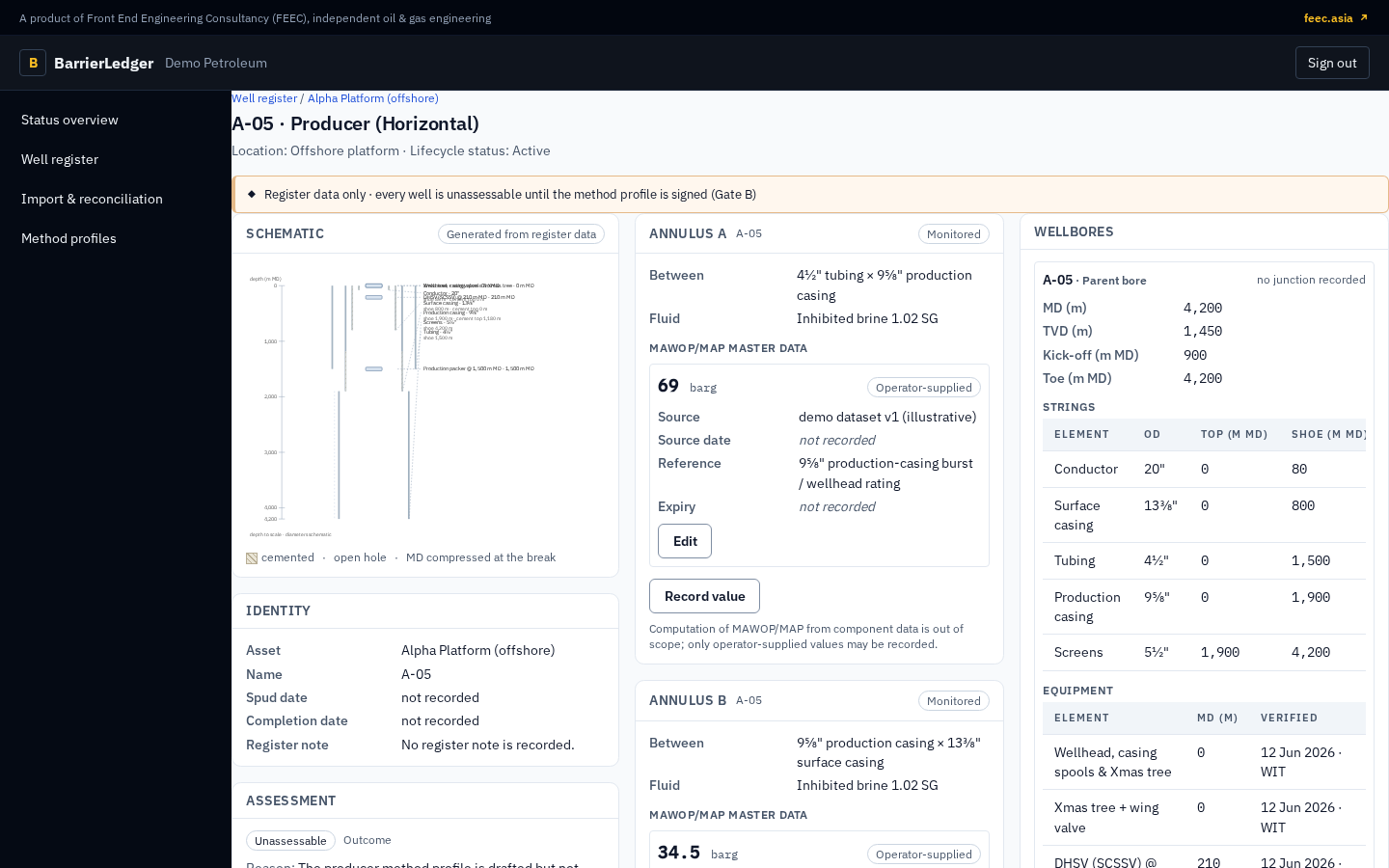
Wells, boreholes, casing and tubing strings, cement tops, packers, wellhead and tree components, and the annuli between them — held in one hierarchy from field to facility to well.
Barrier envelopes and barrier elements are versioned per well, with a rendered schematic.
Annulus pressure monitoring
Bulk-import historical annulus readings, then keep them current from a weekly or monthly template. A reading keeps the unit it was entered in; conversion is display-only.
A, B and C annuli are held per well with their fluid type and density.
MAWOP/MAP bands
Each monitored annulus carries its own MAWOP/MAP value as master data with its source, date and reference — imported with your register or entered directly.
Where both a MAWOP and a MAP are supplied, the assessment compares against the governing limit and records which one governed.
Well integrity tests
Test types and their required frequencies come from your own integrity policy. Due, overdue and upcoming tests sit next to the well they belong to.
Each test record keeps its pressure, acceptance criteria, result and the evidence that closes it.
Schematics and well types
Vertical, deviated, horizontal and multilateral wells are drawn from register data — strings, deviation survey, cement tops, packers and junction metadata.
A missing input renders as a flagged gap in the schematic rather than an assumed value.
Import and reconciliation
Excel-first: a template that mirrors your register, column mapping, per-row validation, and a reconciliation of every status and MAWOP/MAP the platform can check against your own figures.
Every difference is listed with its reason, and the data-quality list names what is missing or stale.
How a status is produced
Readings in, one outcome out, with the trail kept.
The assessment is deterministic and versioned: the same inputs and the same signed profile version produce the same outcome, and a re-run supersedes rather than overwrites.
- 01
Inputs
The period reading and its date basis and unit, the reading history, the governing limit with its source, the profile’s band and trend settings, the tenant unit setting, the profile version, and any override in force.
- 02
Classification
Each monitored annulus is classified against the bands defined in the method profile for that well type, expressed as a percentage of the governing limit.
- 03
Trend and exceptions
A sustained rise over the profile’s configured window raises its own outcome and a bleed-off / SCP diagnostic action. Missing, stale, duplicated and out-of-family data each raise a named exception.
- 04
Outcome and provenance
Exactly one outcome is recorded per assessed annulus per assessment, with the status effect, the flag raised and whether it blocks the review — plus the inputs hash, source-file hashes, method-profile version and engine build.
Exceptions are named, not absorbed
- A monitored annulus with no valid governing limit
- A missing or stale reading for a monitored annulus
- An expired or overdue integrity test
- A reading that is out of range, duplicated or in an ambiguous unit
- A well that cannot be bled to zero (the SCP exception path)
- An annulus with no method configured, or an unknown annulus code
- A well whose type has no signed method profile (reported unassessable)
A well that cannot be bled to zero
One profile per well type
Outputs are in-house integrity reports
Governance
A review you can sign, and a history you can follow.
Integrity status is only useful if someone owns it. BarrierLedger gives the review a state, an approver and an audit trail.
Daily provisional status
Status is visible continuously, and it is provisional until the period it belongs to is reviewed and locked.
Monthly integrity review
Every well assessed, every overdue test flagged, every override approved — the review is a workflow with a state, not a meeting.
Overrides with approval
Who may request and who may approve are set in the method profile, and an unapproved override is not in effect. An override never rewrites the computed result: both are stored alongside each other and both stay visible in history.
Period locking and restatements
A period cannot be marked complete while an unassessable well in it is unresolved or unexempted. A restatement creates a new version; the old one is not overwritten.
Actions register
Corrective actions carry an owner, a due date and the evidence that closes them, and they age visibly.
Audit history
Assessment runs are immutable. A re-run supersedes and never overwrites, and every run keeps the method-profile version it used.
Reports and exports
What comes out.
Reports are the operator’s own documents: the record you prepare a submission or an audit response from, not the submission itself.
Per-well integrity status report
The barrier schematic, the annulus table with the governing limit and its source, the reading trend, and the test history for that well.
Test evidence pack
The test record, its acceptance criteria, its result and the attachments that close it.
Monthly integrity review pack
The reviewed period: status changes, exceptions, overrides and open actions in one export.
Annual integrity summary
A year of status, test and exception history for the wells in scope.
Excel and full data export
Everything you put in, with the assessment history alongside it, exportable at any time.
Data-quality list
Stale readings, missing governing limits, unmapped columns, schematic gaps and wells with no signed profile.
Walk through the working views
- Register overviewStatus across the wells in scope, with the exceptions that need attention.
- Well detailSchematic, annulus table, governing limits and test history for one well.
- Annulus trendReadings over time against the governing limit for that annulus.
- Test complianceDue, overdue and upcoming integrity tests with their evidence.
- Schematics and well typesThe four archetypes drawn from register data.
- Import and reconciliationMapped columns, validated rows and every difference against your register.
- Governance reviewThe monthly review: statuses, exceptions, overrides and approvals.
Specified design — an illustration of the intended screen with fictional demo data, not the live product. The walkthrough opens the interactive mockups for the fictional Demo Petroleum tenant.
Boundaries
What BarrierLedger does not do.
Saying no clearly is part of being usable. These are outside the platform’s scope, and no page on this site should be read as claiming them.
- Drilling and completion-phase integrity
- Subsea trees and subsea wellheads
- Plug-and-abandonment barrier verification
- Leak-detection log interpretation (PLT, USIT, noise)
- SCADA or other real-time ingestion
- Mobile applications
- Regulator filings of any kind
Multilateral junctions
See it on your own wells.
Book a demo and we will walk through the platform on the fictional tenant, then import a register and show you the reconciliation on your own data.